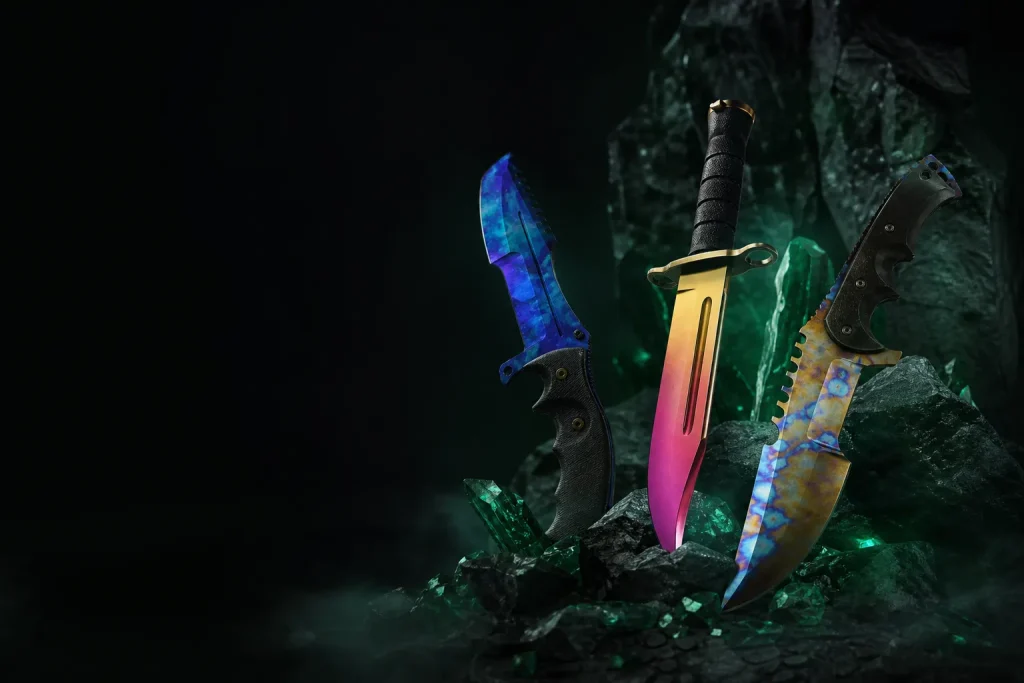
If you’ve ever hovered over a Karambit and wondered why one Fade is worth a cleanly played MR12 and another looks like it got dragged through Inferno molotovs, yeah, that’s knife finishes in CS2. They’re not just paint jobs. They’re a mix of pattern, wear, and weird little quirks that can turn the same knife into two totally different prices.
CS2 made this even more obvious. Source 2 sharpened the lighting, so finishes like Doppler, Marble Fade, and Tiger Tooth pop harder than they did in CS:GO. And because the market cares about flex as much as it cares about fragging, knife finishes have become one of the most obsessive corners of the entire skin scene.
What a knife finish actually is
A knife finish is the visual coating on a knife skin. Think of it as the skin’s style layer: the base knife model stays the same, but the finish decides whether you’re rocking a clean black-and-gold look, a blue gem monster, or something that looks like it was sprayed during a 2014 frag movie.
Most finishes fall into a few buckets:
- Painted finishes like Slaughter or Freehand.
- Plated finishes like Tiger Tooth and Doppler.
- Pattern-based finishes where the texture placement matters a lot more than people think.
- Wear-sensitive finishes that look very different at Factory New versus Battle-Scarred.
The catch? Two knives with the same finish name can look pretty different if the pattern index is different. That’s where the real money lives.
Wear levels matter more than people admit
CS2 skin wear runs from Factory New to Battle-Scarred, and knives are no exception. A Factory New knife usually looks cleaner, brighter, and less scratched, which matters a ton on finishes with reflective surfaces. A Battle-Scarred knife can still be cool, but on some finishes it looks rough enough to make your inventory feel like a bad force-buy.
- Factory New: usually the cleanest look, best for flashy finishes.
- Minimal Wear: often the sweet spot for price-to-look.
- Field-Tested: can be fine, can be cursed.
- Well-Worn: niche buyers only.
- Battle-Scarred: for people who like pain or specific collectors.
There’s no one-size-fits-all answer here. A Battle-Scarred skin on some knives can still look pretty decent, while on others it’s basically a budget sabotage move.
Pattern index is where things get stupid expensive
Here’s the part a lot of newer players miss. Some knife finishes aren’t just about wear; they’re also about pattern. That means the texture’s placement on the knife changes based on a hidden pattern index. Same finish name, different visual result, totally different price.
The big examples are obvious if you’ve been around the scene for a while:
- Doppler phases can shift the color mix a lot.
- Ruby, Sapphire, and Black Pearl variants are the expensive ones everyone screenshots on Twitter.
- Fade knives with high fade percentages are way more desirable.
- Marble Fade patterns can have better “fire and ice” setups.
- Case Hardened knives can pull blue gems, and that’s where prices go completely unhinged.
Case Hardened is the king of this nonsense. A random blue-heavy pattern can jump from “nice knife” to “you could buy a used car” real fast, and the market treats it like a religious artifact.
The finishes people actually chase
Not every knife finish gets the same hype. The community has favorites, and some are just better-looking in Source 2’s lighting. If you’re spending real money, these are the names that keep showing up.
- Doppler — slick, dark, expensive, and stupidly popular.
- Gamma Doppler — the green tones hit hard, especially on some knives.
- Fade — simple idea, massive flex if the percentage is high.
- Marble Fade — classic flashy finish, still one of the safest style picks.
- Tiger Tooth — bright gold, very “I just aced you on Mirage cat.”
- Slaughter — red-and-silver chaos, old-school and still respected.
- Freehand — underrated, especially if you want something less obvious.
My take? Doppler and Fade are still the easiest “rich-looking” choices. Marble Fade is the all-time safe pick. Case Hardened is for people who enjoy spreadsheets and stress.
Why some finishes look better in CS2
Source 2 changed the way light bounces off surfaces, and knife finishes benefit a ton from that. Shiny materials look shinier. Dark finishes get cleaner contrast. Certain blues and pinks on Doppler variants pop harder than they did in CS:GO, which is exactly why some older knife owners suddenly felt very smug in Premier.
Subtick doesn’t matter for knife skins directly, obviously — you’re not improving your backstab timing because your Karambit is a Sapphire — but CS2’s presentation absolutely changes how skins feel in-game. A knife that looked a bit flat before can now look like a full-on collector’s piece under the right map lighting.
Try it on Mirage B apps, then check it again on Nuke outside near secret. Same knife, different vibe. Valve’s lighting has opinions.
Knife models and finishes are tied together
Finish matters, but so does the knife model itself. A finish that looks decent on a Gut Knife can look elite on a Butterfly, and that same finish might look kind of awkward on a Navaja because the blade shape just doesn’t carry the style well.
The knives people usually care about most:
- Karambit — still a top-tier flex, no debate.
- Butterfly Knife — animations sell the whole thing.
- M9 Bayonet — chunky, aggressive, very CS.
- Huntsman — underrated if you want a bigger blade.
- Skeleton Knife — weirdly popular for how ugly it looked at launch.
Butterfly knives are especially funny because the inspect animation does half the work. A mediocre finish on a Butterfly can still look sick just because the animation is so smooth and obnoxiously stylish.
How to judge a knife finish before you buy
If you’re shopping on the market, don’t just stare at the name and assume you’re good. Check the pattern. Check the float. Check screenshots in-game if you can. A Steam Market thumbnail is not enough, and if you’re dropping $500 to $5,000, you should know exactly what you’re getting.
- Look at the float first.
- Search the pattern index if the finish has one.
- Compare it under bright map lighting, not just the menu.
- Decide if you care about resale or just your own eyes.
That last one matters. Some players buy for flex, some buy for profit, and some just want to pull out a knife on Ancient and feel slightly more dangerous while lurking B temple for the seventh round in a row.
Are expensive knife finishes actually worth it?
If you’re asking from a pure gameplay angle, no. A knife finish doesn’t make your aim better on Mirage mid or stop you from throwing a trash smoke on Inferno banana. You can still get rolled by a guy with a default knife and a $2 loadout.
If you’re asking from the real CS angle — the one where people stare at inventories, compare loadouts, and judge each other after a 13-11 win in Premier — then yeah, they can be worth it. A good knife finish is part personal taste, part market flex, part “I’ve been around this game long enough to care about dumb details.”
And honestly, that’s very CS. We’ll argue about economy every round, call for a save on 2v4, then spend three hours comparing how a Doppler looks under Anubis water lighting. Makes sense to me.
The cleanest rule is simple: buy the finish you actually like seeing every time you inspect it, because you’ll do that way more than you’ll ever think about the sticker on your rifle.